0%

Choosing a custom activewear manufacturer is not simply a search for the lowest quotation. It is a decision about fabric performance, production control, communication, and long-term brand risk. Grand View Research valued the global sports apparel market at approximately USD 203.5 billion in 2023. Its forecast also suggests continued growth through 2030. That growth creates opportunity, but it attracts inexperienced suppliers too.

A reliable manufacturer should prove its capabilities with physical evidence. Ask for fabric composition, GSM, stretch recovery, colorfastness, and pilling-test results. Request a sample made from the same fabric used in bulk production. A polished showroom sample can hide weak stitching. It happens. The supplier should also explain minimum order quantities, lead times, quality checkpoints, and corrective-action procedures. Textile Exchange’s Materials Market Report 2024 reported that polyester represented about 57% of global fiber production in 2023. Therefore, material traceability and recycled-content claims deserve careful verification, not casual promises.

Custom activewear manufacturing requires technical judgment at every stage. Review the factory’s experience with flatlock seams, bonded panels, elastic tension, compression fabrics, and moisture management. Check whether an independent laboratory can verify performance claims. The Sustainable Apparel Coalition’s Higg Facility Environmental Module is one useful reference, although no single assessment proves complete sustainability. A scorecard helps compare suppliers, yet it cannot replace factory visits, transparent records, and consistent sample reviews. I would leave room for doubt. Forecasts change, certifications expire, and even experienced factories make mistakes. The strongest partnership comes from documented standards, realistic timelines, and honest conversations before production begins.
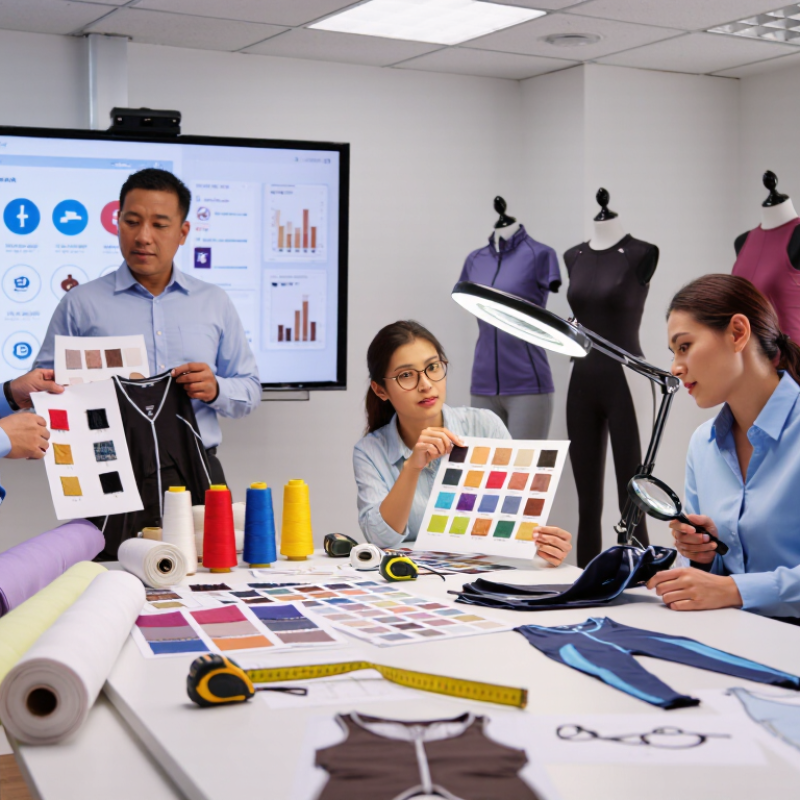
How to Choose a Custom Activewear Manufacturer?

Define Product Scope Within a Market Forecast at 9.6% CAGR

How to Choose a Custom Activewear Manufacturer?

The global activewear market is projected to grow at a 9.6% CAGR from 2024 to 2030, according to Grand View Research’s Global Activewear Market Size, Share and Trends Analysis Report. Treat that figure as a planning signal, not a guarantee. Market forecasts can shift with inflation, weather, and consumer spending. Define your product scope before requesting factory quotes. Specify leggings, sports bras, training tops, or complete sets. Then document fabric weight, stretch recovery, moisture management, color range, size grading, and target price.

Keep the forecast practical. A small collection with three core styles may test demand better than fifteen unproven designs. Textile Exchange’s Materials Market Report 2024 identifies polyester as the largest synthetic fiber category, but recycled content, nylon blends, and elastane percentages affect cost and performance. Ask manufacturers for fiber certificates, test reports, and fabric composition records. Request samples after washing, stretching, and repeated wear. The first sample may look perfect.

It may not perform perfectly. That matters.

Choose a manufacturer with proven experience in technical stitching, flatlock seams, gussets, waistband construction, and print durability. Check production capacity against your expected order volume, not only the quoted minimum order quantity. Confirm quality checkpoints, inspection methods, lead times, and corrective-action procedures in writing. The McKinsey and World Federation of the Sporting Goods Industry Sporting Goods 2024 report highlights continued consumer attention to value and product functionality. Your supplier should explain how each design feature supports both. Beware of vague promises. Ask for measurable tolerances.

Screen Manufacturers for ISO 9001 and OEKO-TEX Standard 100 Compliance

Choosing a custom activewear manufacturer requires more than comparing prices and sample photos. Check ISO 9001 certification first. The ISO Survey 2023 recorded more than 1.2 million ISO 9001 certificates worldwide. This scale shows its importance, but certification alone cannot guarantee excellent leggings or sports bras.

Request the current certificate, issuing body, expiry date, and exact production scope. The scope should cover relevant activities, such as fabric inspection, cutting, sewing, and final testing. Ask how the factory handles rejected panels, measurement errors, and corrective actions. A useful manufacturer can show inspection records, not just polished certificates. Visit the sewing floor if possible. Look for labeled fabric rolls, calibrated equipment, and traceable batch records.

Then verify OEKO-TEX Standard 100 certification for the actual product and materials. Confirm the certificate number, product class, covered components, and validity period. Elastic, thread, prints, labels, and dyeing processes may require separate attention. OEKO-TEX’s published certification framework emphasizes testing harmful substances across textile components, not merely finished fabric. That distinction matters for skin-contact activewear. Ask for recent laboratory reports and production samples from the same material lot. Never rely on a certificate copied into an email.

Paperwork can still mislead me. A factory may hold ISO 9001 certification while subcontracting key processes elsewhere. Therefore, compare the certificate scope with the real production route. This extra check takes time, but it exposes weak traceability before bulk orders begin.

Compare MOQ, Lead Times, and AQL 2.5 Quality Benchmarks

Choosing a custom activewear manufacturer requires more than comparing price per piece. MOQ, lead time, and AQL 2.5 should be reviewed together. McKinsey and The Business of Fashion’s State of Fashion 2024 projected global fashion growth of only 2–4%. That makes excess inventory expensive. A lower MOQ can protect cash flow, but it may increase fabric costs or reduce color options. Ask for a written MOQ by style, color, and size ratio.

Lead time should be divided into sampling, material booking, production, and inspection. A factory promising 30 days may exclude fabric delays. Request a production calendar with approval deadlines. For quality, AQL 2.5 is a sampling benchmark, not permission to ship 2.5% defective garments. ANSI/ASQ Z1.4 and ISO 2859-1 use lot size and inspection levels. For example, a 3,201–10,000-piece lot may require inspecting 200 pieces under General Level II. The acceptance number depends on the selected AQL table. Define critical, major, and minor defects separately. Zippers, seam strength, fabric shade, and measurements need different checks.

Tips: Compare three written quotations. Record every assumption. Ask for recent anonymized inspection records and a corrective-action report. AQL sampling cannot replace process control. I would also test one wash cycle before approval. It is a small step, but overlooking shrinkage still happens. A factory with a low MOQ and fast lead time may look attractive, yet inconsistent grading can create costly returns. Trade data from the WTO shows clothing remains a large global supply category, so supplier capacity can change quickly during peak seasons. Leave schedule space. Perfect forecasts rarely exist.

How to Choose a Custom Activewear Manufacturer?

Compare MOQ, production lead time, and AQL 2.5 inspection sample requirements across typical sourcing profiles.

Smaller MOQs can reduce inventory risk but may involve higher unit costs. Lead times commonly increase with order complexity and volume. The AQL 2.5 sample sizes follow ISO 2859-1 general inspection level II lot-size categories; Ac/Re means the maximum accepted and minimum rejected defective counts in the sample.

Test Fabric Performance Using GSM, Stretch, and ASTM D4966 Abrasion Data

Choosing a custom activewear manufacturer requires more than checking fabric color and sample appearance. Fabric performance must be measured before bulk production. GSM, stretch, and abrasion data reveal how material may behave during training, washing, and repeated movement.

GSM measures fabric weight per square meter. A higher GSM can feel supportive, but it does not automatically mean better quality. Compare the same fabric after dyeing and finishing, because these processes may change its weight. Test stretch in both directions. Record extension, force, and recovery after repeated pulls. A waistband that stretches easily but stays loose can fail during a real workout. Ask the manufacturer for test conditions, not only attractive percentages.

Abrasion testing adds another practical layer. ASTM D4966, commonly used with Martindale equipment, measures resistance against rubbing under controlled pressure. Request the tested fabric construction, load, abrasive material, and cycle count. A high cycle result is useful, but it cannot predict every snag, seam failure, or pilling issue. Inspect the fabric after testing. Look for thinning, fuzzing, color loss, and broken yarns. Small details matter. I have seen lightweight fabric pass a basic abrasion test yet feel weak at the hip seam. That is why samples should include movement trials and wash checks. Test results are evidence, not a complete promise.

Approve Samples, Landed Costs, and Compliance Before Signing a Contract

How to Choose a Custom Activewear Manufacturer?

A polished sample can still fail after washing. I have made that mistake. Test every style through repeated washing, stretching, sweating, and drying before approving production. Record measurements before and after each test. Check fabric recovery, colorfastness, pilling, seam strength, waistband pressure, and print adhesion. Ask the manufacturer to provide test methods and laboratory results, not verbal promises. Textile Exchange’s Materials Market Report 2024 recorded global fiber production at 124 million tonnes in 2023. That scale makes material traceability increasingly important.

Landed cost needs a written calculation. Include fabric, trims, sampling, packaging, inspection, freight, insurance, duties, taxes, and payment charges. Ask for three scenarios with different quantities and shipping methods. A low factory price may hide expensive air freight or excessive minimum orders. Get it in writing. Leave a small contingency because freight rates and customs assessments can change. My imperfect rule is simple: if the supplier cannot explain one cost clearly, do not treat the quotation as final.

Compliance must be checked before signing. Request fiber-content records, restricted-substance testing, social-audit evidence, factory addresses, and subcontractor disclosure. The OECD Due Diligence Guidance for Responsible Supply Chains in the Garment and Footwear Sector recommends risk-based checks across the supply chain. Use that approach rather than accepting a single certificate. Also verify labeling, chemical, labor, and product-safety requirements in every target market. A contract should define testing, corrective actions, rejected goods, delivery delays, and document ownership. Samples first. Contract later.

How to Choose a Custom Activewear Manufacturer? - Approve Samples, Landed Costs, and Compliance Before Signing a Contract

A practical pre-contract evaluation framework for comparing manufacturers without relying on company or brand names.

Evaluation Area Dimension / Checkpoint Reference Data or Formula Evidence to Request Recommended Decision Rule Status
1. Sample Approval Before Bulk Production
Product specification Measurement tolerance Usually ±0.5–1.0 cm Approved tech pack, graded measurement chart, and signed pre-production sample report. Confirm the tolerance for every key point of measure, including waist, hip, inseam, rise, and garment length. Approve if documented
Fabric performance Stretch and recovery Test in both width and length directions Fabric composition, GSM report, stretch test, and recovery test after repeated extension. Approve only when the test method and minimum performance values are written into the product specification. Conditional
Colorfastness Resistance to washing, perspiration, and crocking Use a recognized textile test method and defined grade requirement Laboratory test report for the exact fabric color and construction. Do not approve a color based only on visual comparison; require test results for dark, neon, and contrast colors. Approve with test report
Opacity Sheerness during stretch and movement Check at the intended stretch level, not only when relaxed Wear test, stretch-panel inspection, and photos or video under consistent lighting. Reject if the garment becomes visibly transparent in the intended size and activity range. Reject if transparent
Construction quality Seams, coverstitch, flatlock, waistband, and elastic Inspect stress points and repeated movement areas Inside-out sample photos, seam specification, stitch-per-inch requirement, and wash test results. Approve only after checking seam comfort, skipped stitches, puckering, thread tension, and elastic recovery. Approve after inspection
Sample revision control Numbered sample iterations Record each revision as Sample 1, Sample 2, and Final PPS Signed comments, dated photos, measurement comparison, and final approval record. The final production sample must match the signed version in fabric, color, trims, labels, measurements, and workmanship. Required
2. Landed Cost and Commercial Review
Unit cost Factory price per finished garment Quote by style, size range, color, and order quantity Formal quotation showing materials, labor, packaging, testing, and tooling charges. Compare like-for-like specifications; a lower price is not comparable if fabric weight, trims, testing, or packaging are excluded. Compare carefully
Landed-cost formula Total cost delivered to the agreed destination Landed cost = product cost + packaging + testing + freight + insurance + duties + import fees + broker fees Incoterm, freight quotation, tariff classification, duty estimate, customs fees, and destination charges. Use the same destination, shipment mode, currency, and delivery term for every supplier comparison. Required
Incoterms Responsibility for transport, risk, and customs clearance Specify the named place and Incoterms version, such as Incoterms 2020 Quotation and contract showing the exact term and named place. Do not compare an origin-based quotation with a delivered quotation without adding all missing logistics and import costs. Must be explicit
Minimum order quantity MOQ by style, color, and size MOQ may apply separately to fabric, color, and finished goods MOQ schedule, surcharge list, and fabric minimums from mills or material suppliers. Confirm whether the MOQ is per style, color, colorway, or total order before signing. Confirm in writing
Payment exposure Deposit, balance, and ownership of work in progress Write payment milestones and inspection rights into the contract Pro forma invoice, payment schedule, cancellation terms, and pre-shipment inspection clause. Balance payment should be linked to agreed inspection or release conditions rather than shipment alone. Contract control
Cost-change protection Price validity and raw-material adjustments Define the quotation validity period and change-notice requirement Price-validity clause, approved material list, and written change-control procedure. Require written approval before substituting fabric, trims, labels, packaging, or manufacturing processes. Required
3. Compliance and Traceability Before Contract Signing
Market requirements Destination-country legal obligations Requirements vary by selling market and product category Compliance matrix covering chemical, labeling, flammability, product-safety, and packaging requirements. Identify the destination markets before sampling so the correct tests and labels are included from the start. Required
Chemical compliance Restricted substances in fabric, dyes, prints, coatings, and trims Review applicable restricted-substance lists, including market-specific chemical rules Recent test reports for the exact production materials, supplier declarations, and restricted-substance list. Test the final assembled product when multiple materials, prints, coatings, or accessories are used. Approve with reports
Fiber and care labeling Fiber composition, country-of-origin, care instructions, and size information Label content and format depend on the destination market Artwork proof, label specification, care-symbol references, and translation review where required. Approve labels only after checking legal content, language, durability, placement, and consistency with the actual garment. Required
Social and ethical sourcing Workplace safety, wages, working hours, and forced-labor controls Use a documented supplier code and risk-based assessment Facility address, subcontractor list, audit records, corrective-action plans, and worker-safety documentation. Reject undisclosed subcontracting and require written approval for every external production location. Reject if undisclosed
Quality inspection plan Inspection level and defect classification AQL sampling is commonly based on ISO 2859-1; define critical, major, and minor defects Inspection procedure, sampling plan, defect glossary, and approved limit for each defect class. Put the inspection standard in the contract; do not rely on the phrase “standard quality.” Contract requirement
Traceability Material and production records Trace fabric lot, dye lot, trims, production line, and shipment carton Purchase records, lot codes, batch records, carton marks, and production dates. Approve only when a quality issue can be traced back to the relevant material and production batch. Verify system
4. Final Pre-Contract Gate
Approval package Complete commercial, technical, and compliance file One controlled file containing the final specification and supporting evidence Final PPS approval, graded spec, fabric and trim approvals, test reports, landed-cost sheet, and inspection plan. Do not sign or release bulk production until every open item has an owner, deadline, and written disposition. Ready to sign
Contract safeguards Specification control, defects, delays, substitutions, and remedies Attach the approved technical package as a contract exhibit Signed contract, specification annex, delivery schedule, quality remedies, and dispute procedure. Ensure the contract gives the buyer approval rights over material changes, subcontracting, and production release. Required
Decision principle: approve the manufacturer only when the final sample, complete landed-cost calculation, destination-market compliance file, inspection plan, and contract controls are consistent with one another.

FAQS

What should I define before requesting activewear manufacturer quotes?

Define the product scope clearly. List leggings, sports bras, tops, or complete sets. A small three-style collection may test demand better than fifteen designs. Record fabric weight, stretch, recovery, moisture control, colors, sizes, and target price.

How should I use activewear market growth forecasts?

Treat a projected 9.6% annual growth rate as a planning signal, not a promise. Inflation, weather, and consumer spending can change the outcome. Forecasts help planning, but real customer feedback matters more.

What manufacturing experience should I check?

Look for technical stitching experience and strong construction details. Check flatlock seams, gussets, waistbands, and print durability. Ask for measurable tolerances, not vague promises. Pictures are not enough.

Which certification documents should a manufacturer provide?

Request current quality-management and textile safety certificates. Check the issuing organization, expiry date, certificate scope, and covered production activities. The scope should include cutting, sewing, fabric inspection, and final testing. A copied certificate proves very little.

How can I check whether production records are reliable?

Ask for inspection records, batch tracking, rejected-panel procedures, and corrective-action reports. Confirm whether outside factories handle dyeing, printing, or other key processes. Visit the sewing floor when possible. Look for labeled fabric rolls and calibrated equipment.

What fabric performance tests should I request?

Request fabric weight, stretch, recovery, and abrasion results. Fabric weight is measured in grams per square meter. Test stretch in both directions and record recovery after repeated pulls. A soft waistband can still become loose.

How should abrasion testing be interpreted?

Request the tested fabric structure, pressure, abrasive material, and cycle count. High abrasion resistance does not guarantee perfect seams or zero pilling. Inspect for thinning, fuzzing, broken yarns, and color loss. Tests are evidence, not a complete promise.

What sample checks should happen before bulk production?

Wash, stretch, and repeatedly wear every sample. Check waistband recovery, hip seams, print durability, fabric weight, and color stability. Compare the sample with the approved material lot. The first sample can fool you. I would still test it again.

Conclusion

Choosing a custom activewear manufacturer starts with defining your product scope, target customer, performance requirements, and pricing position within a market forecasted to grow at a 9.6% CAGR. During supplier screening, prioritize manufacturers that can demonstrate ISO 9001 quality management and OEKO-TEX Standard 100 material compliance. Compare minimum order quantities, production lead times, communication processes, and AQL 2.5 inspection benchmarks to ensure the partnership fits your operational needs.

Before making a commitment, evaluate fabric performance through GSM, stretch recovery, durability, and ASTM D4966 abrasion data. Request samples that represent the intended design and test their construction, comfort, colorfastness, and wash performance. You should also calculate landed costs, including manufacturing, packaging, freight, duties, and quality inspections. Finally, confirm all specifications, testing requirements, delivery terms, and compliance documents before signing a contract. A structured approach to Custom activewear manufacturing can reduce risks and support consistent product quality.


Evelyn

Evelyn

Evelyn is a dedicated marketing professional with a strong understanding of the company’s products, customers, and industry landscape. With a talent for transforming complex product information into clear, practical, and engaging content, she regularly contributes expert articles to the company’s......