Custom streetwear production begins with more than an attractive logo. It requires a clear product idea, realistic costing, and dependable manufacturing partners. A founder must decide what the garment should feel like in real life. Is the hoodie heavy enough for winter? Does the print survive repeated washing? Can the factory reproduce the same charcoal shade across multiple batches?
Bobby Hundreds, co-founder of The Hundreds, wrote, “A brand is a story unfolding across all customer touch points.” That idea matters deeply in production. Fabric weight, stitching, labels, packaging, and delivery all communicate your brand’s story. A strong design can lose credibility through weak seams or careless sizing. Small details speak loudly.
The process usually starts with a technical pack, fabric research, pattern development, and a carefully reviewed sample. Discuss minimum order quantities early. Ask about sample fees, production timelines, quality inspections, and responsible workplace standards. Request fabric composition and colorfastness information before approving bulk production. Keep every decision documented.
The first sample may disappoint. Good.
It can reveal unclear measurements, awkward proportions, or a print that feels too loud. Not every mistake needs an expensive redesign. Sometimes, a simpler adjustment protects both quality and cash flow. Custom streetwear production works best when creativity meets patient testing, honest supplier communication, and measurable standards. Your first collection does not need perfection. It needs evidence that customers will trust, wear, and remember.
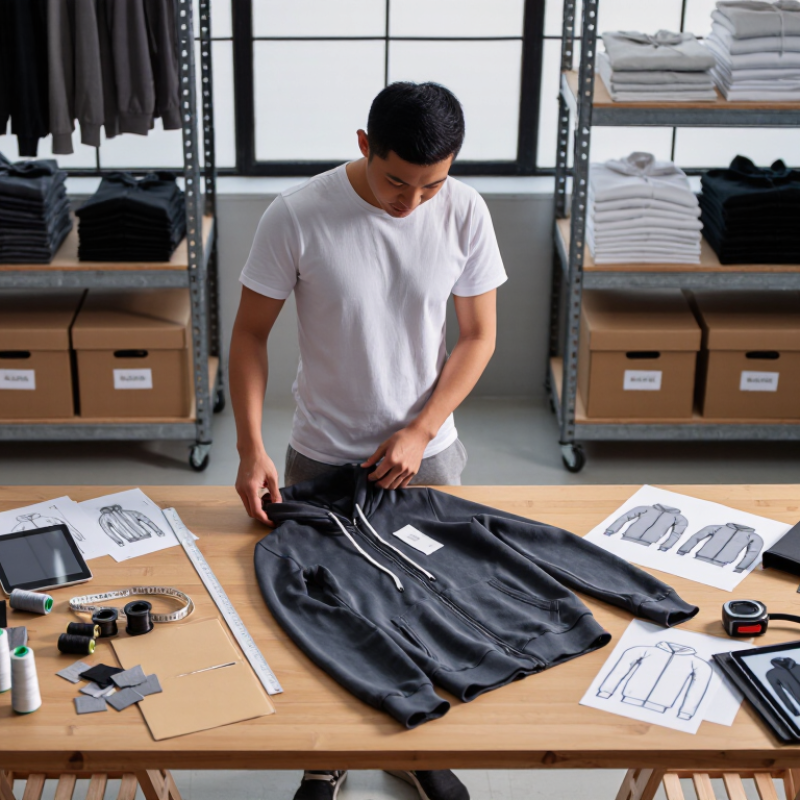
How to Start Custom Streetwear Production for Your Brand
Grand View Research reports a 9.1% compound annual growth rate for the streetwear market. This figure signals expanding demand, not guaranteed sales. CAGR measures market growth over time, while your label still needs proof from real customers. Study local prices, preferred fits, and repeat-purchase behavior before ordering large quantities.
A practical test starts with one focused capsule. Consider heavyweight cotton hoodies, relaxed trousers, or graphic T-shirts. Request samples with exact measurements, fabric weight, stitching details, and wash instructions. Check shrinkage after washing. It matters. Ask several factories about minimum order quantities, lead times, payment terms, and quality-control procedures. Keep written records for every revision.
Market growth can support a production plan, but poor forecasting can create expensive deadstock. I would begin with a limited run and collect feedback through preorders or small retail tests. Track which sizes sell, where customers hesitate, and whether the fabric feels worth the price. Some early assumptions may fail. That is useful evidence, not defeat. Review the results before adding colors or increasing quantities. A responsible supplier should also provide clear material information and follow applicable labor, safety, labeling, and environmental requirements. Growth is valuable only when production remains consistent, transparent, and financially manageable.
Market-sizing and production-planning reference table for launching a custom streetwear collection. Global market values below are approximate calculations based on the reported 2023 market size and forecast CAGR.
| Data Dimension | Value | What It Means for Production Planning | Data Basis |
|---|---|---|---|
| Global streetwear market size, 2023 | US$185.1 billion | Provides a broad indication of the addressable global market for casual, graphic, athletic-inspired, and lifestyle apparel. | Grand View Research market estimate |
| Forecast compound annual growth rate | 9.1% CAGR | Supports a growth-oriented launch strategy, while actual demand will depend on region, product category, price point, and distribution channel. | Grand View Research forecast for 2024–2030 |
| Estimated global market size, 2024 | US$202.0 billion | Useful as the first annual benchmark when setting a launch-year market narrative and investment plan. | Derived from US$185.1 billion × 1.091 |
| Estimated global market size, 2025 | US$220.3 billion | Indicates the potential scale of demand one year after launch, subject to the assumptions of the published forecast. | Derived using a 9.1% annual compound growth rate |
| Estimated global market size, 2026 | US$240.4 billion | Can be used as a medium-term reference when planning repeat collections, broader sizing, or additional sales channels. | Derived using a 9.1% annual compound growth rate |
| Estimated global market size, 2027 | US$262.3 billion | Highlights the potential value of building reliable sampling, quality-control, and replenishment processes early. | Derived using a 9.1% annual compound growth rate |
| Estimated global market size, 2028 | US$286.1 billion | Supports long-term planning for a wider product architecture, including tops, bottoms, outerwear, and accessories. | Derived using a 9.1% annual compound growth rate |
| Estimated global market size, 2029 | US$312.2 billion | Creates a reference point for scaling production capacity without assuming that market growth will automatically translate into brand sales. | Derived using a 9.1% annual compound growth rate |
| Estimated global market size, 2030 | US$340.6 billion | Represents the approximate end of the cited forecast period and can inform long-range sourcing and operational planning. | Derived using a 9.1% annual compound growth rate |
| Core launch product categories | T-shirts, hoodies, sweatshirts, joggers, and outerwear | These categories cover common streetwear silhouettes and allow a new collection to test different price points and use cases. | Common streetwear product categories; not a company-specific dataset |
| Primary customization methods | Screen printing, embroidery, direct-to-garment printing, heat transfer, and woven labels | Choose the decoration method according to artwork complexity, fabric composition, durability requirements, order quantity, and target cost. | Established apparel-production methods |
| Pre-production validation sequence | Tech pack → prototype → fit sample → size set → pre-production sample | Following this sequence helps identify measurement, construction, artwork-placement, and grading problems before bulk manufacturing. | Standard apparel product-development workflow |
| Key specification fields for a tech pack | Measurements, tolerances, fabric, GSM, trims, stitching, artwork placement, labels, packaging, and inspection requirements | A complete specification package reduces ambiguity between design, sampling, sourcing, and production teams. | Standard technical-design documentation fields |
| Demand validation approach | Small initial assortment with preorder, limited release, or controlled inventory | Testing demand before committing to large production quantities can reduce excess inventory and improve size-curve decisions. | Inventory-risk management practice |
| Core launch performance indicators | Sell-through rate, return rate, gross margin, defect rate, repeat purchase rate, and average order value | These metrics connect market interest with production quality, commercial viability, and customer satisfaction. | Common apparel retail and manufacturing KPIs |
It suggests market growth over time, not guaranteed sales for your label. Test local prices, fits, and repeat purchases first. Growth is not proof.
Start with one small capsule collection. Use hoodies, relaxed trousers, or graphic T-shirts. Try preorders or a limited retail test before placing a large order.
Request exact measurements, fabric weight, stitching details, and wash instructions. Wash the sample and measure shrinkage afterward. Check sleeve openings carefully. Small errors become costly.
Include graded sizes, stitch details, fabric weight, print placement, labels, and tolerance limits. Add revision dates and approval notes. A missing measurement can derail production.
Cutting, sewing, finishing, and inspection may represent roughly 60–70% of apparel production costs. Treat this as a planning benchmark, not a fixed quote. Separate labor, trims, packaging, sampling, and freight.
A factory may accept 100 pieces, but setup costs can increase the unit price. Ask about fabric minimums, color minimums, and sampling charges. Small runs reduce deadstock risk.
Allow about six to ten weeks after materials receive approval. Include sample revisions, fabric booking, bulk cutting, sewing, and inspections. Leave buffer time. Delays happen.
Request written labor policies, grievance procedures, safety records, and corrective-action documents. Check emergency exits, lighting, ventilation, and worker communication. Review energy, water, chemical, wastewater, and waste records. One polished questionnaire is not enough.
Track which sizes sell, where customers hesitate, and whether fabric feels worth the price. Review results before adding colors or increasing quantities. Some assumptions will fail. That is useful evidence.
Custom streetwear production requires a structured plan that connects market research, product development, factory selection, and quality control. Begin by evaluating demand and growth potential, using the projected 9.1% streetwear CAGR as a reference for estimating market size and setting realistic sales objectives. Build detailed tech packs that define materials, construction, sizing, target MOQ, production lead time, and budget. Since apparel CMT costs can represent roughly 60–70% of total production expenses, accurate costing is essential for protecting margins and avoiding unexpected changes.
Factory selection should consider labor practices, environmental performance, production capacity, and documented compliance with recognized ILO standards and Higg FEM assessment benchmarks. Before bulk manufacturing, approve samples through AQL 2.5 inspections and establish acceptable measurement tolerances of approximately 3–5%. Finally, use phased production, inventory discipline, and demand-based replenishment to manage risk. With fashion growth expected to remain in the low single digits, a focused launch and flexible production strategy can support sustainable expansion.